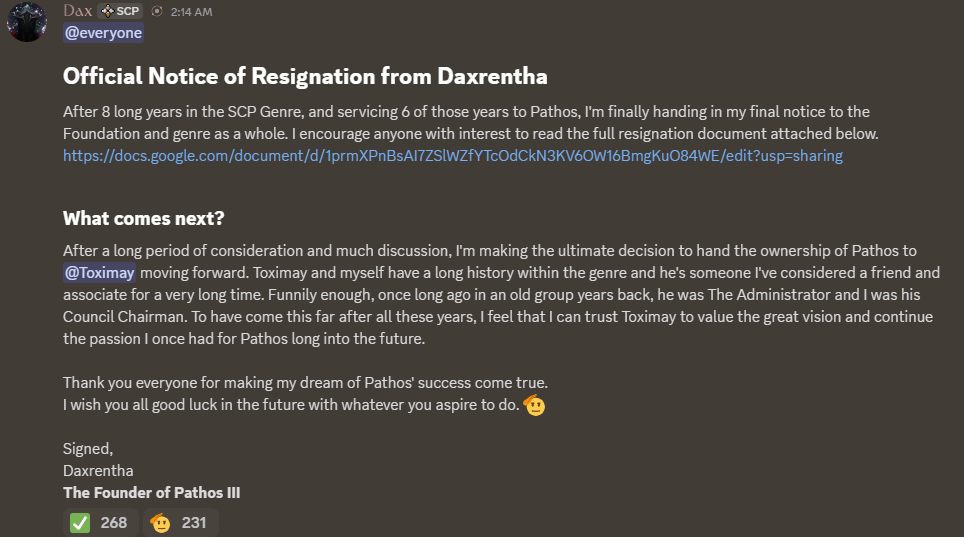
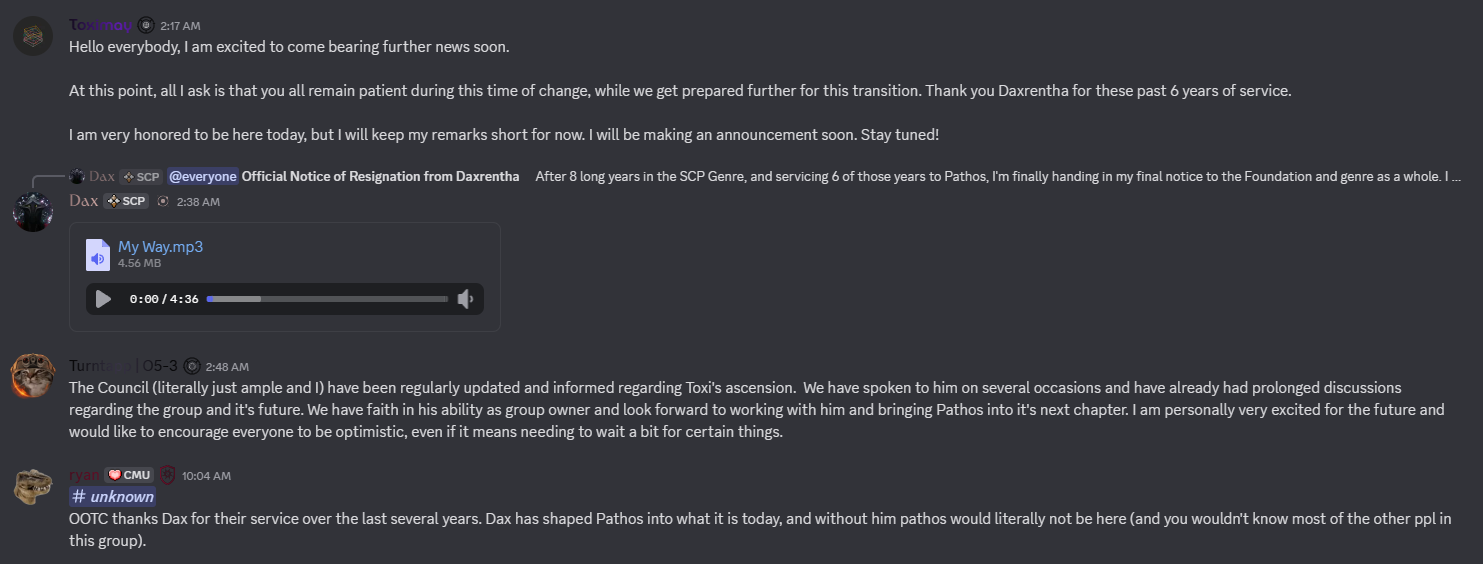
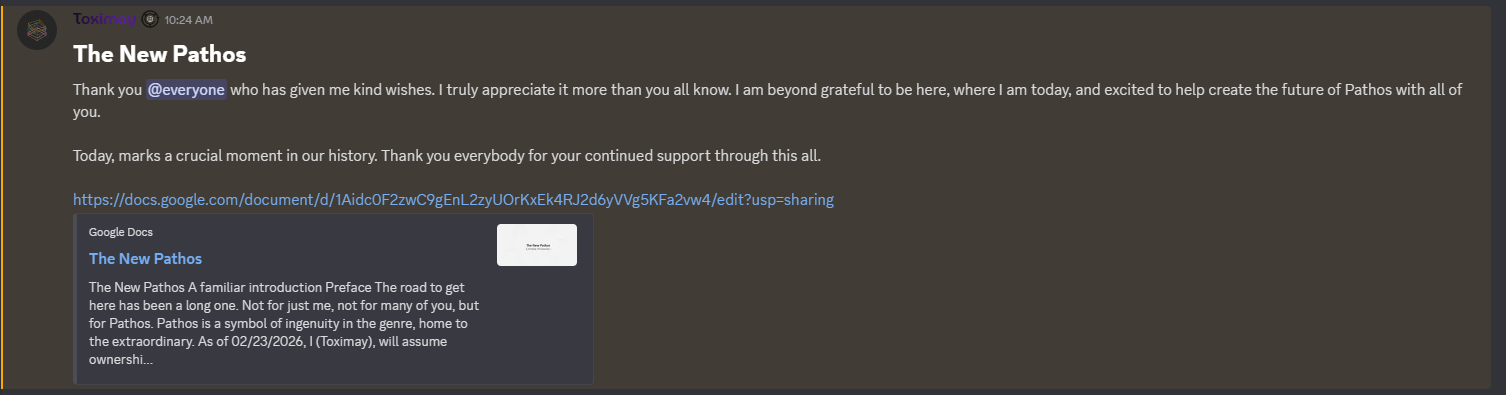
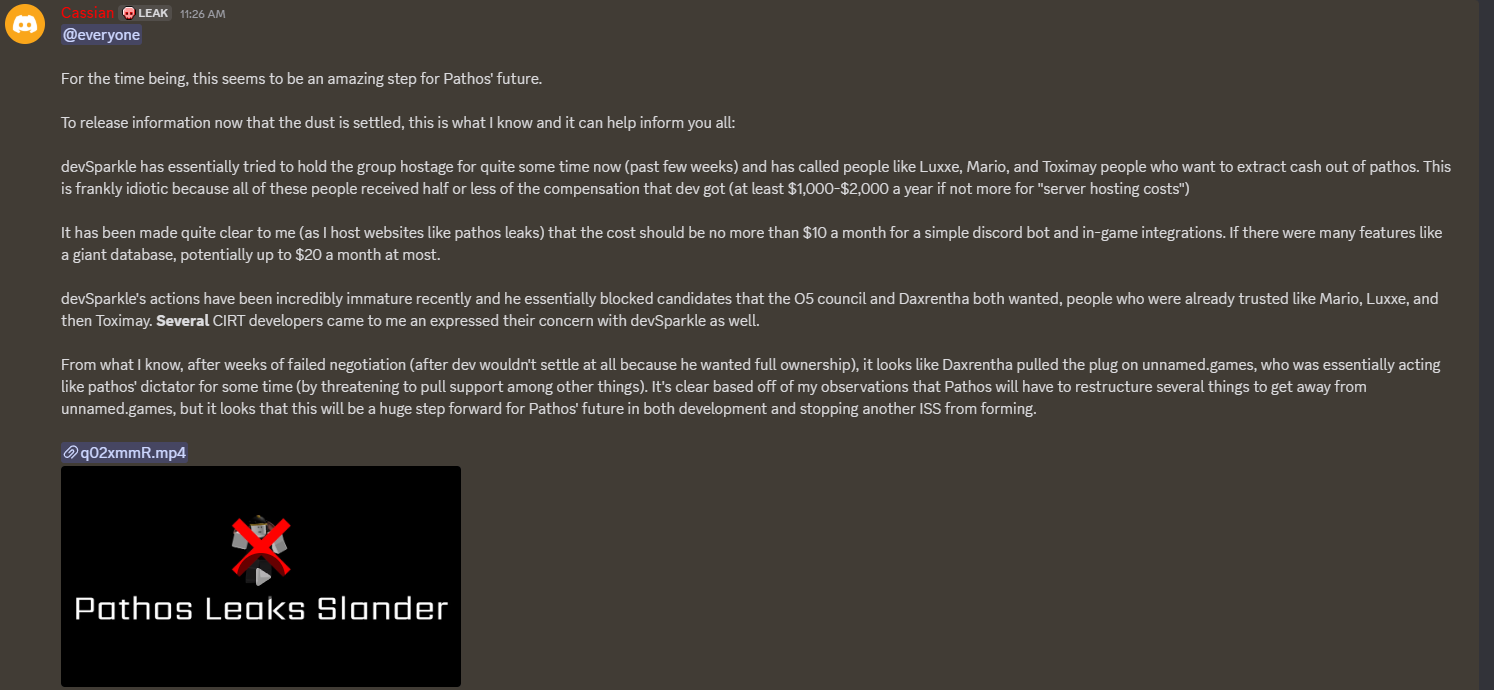
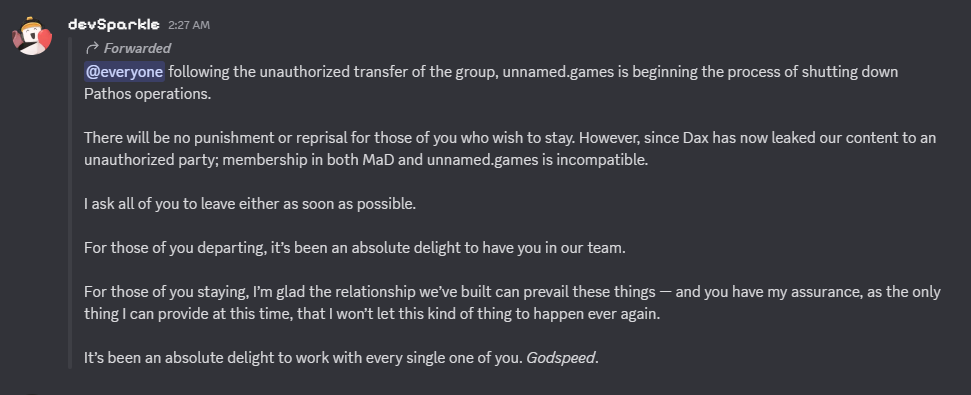
They wrote a legal separation agreement. A real one. Eighteen sections, subsections labeled with Roman numerals, governing law clauses, a dispute resolution framework, signature blocks at the bottom. For a Roblox group. Someone sat down, probably in a Google Doc, and typed the words "SEPARATION & MUTUAL RELEASE AGREEMENT" at the top of a document about who gets to keep the fake SCP containment facility. Then they kept typing for 315 more lines. Nobody stopped them. Nobody closed the laptop. Nobody said the words "we are arguing about a children's game" out loud. They just kept going.
The full title is "UNNAMED.GAMES & PATHOS-III SEPARATION & MUTUAL RELEASE AGREEMENT." It runs 315 lines. It defines the Parties. It references principal addresses. It has a severability clause. It has an assignment restriction clause. It has a clause about clauses. If you printed it and handed it to a first-year law student, they would read six pages before realizing it was about a children's game on Roblox. If you handed it to a second-year law student, they would realize immediately, because the word "Robux" appears next to the phrase "commercially reasonable period."
I. The Parties
On one side: Krescent, acting on behalf of PATHOS-III, which the agreement helpfully defines as "the Roblox community currently known as [SCPF - Special Containment Procedures Foundation] together with its associated Roblox game(s), branding, lore, original in-game assets, official community platforms (including Discord servers), media, and related intellectual property." That is one sentence. It has nine commas. It defines a Roblox group with the same specificity you would use to define a multinational holding company. On the other side: unnamed.games, referred to throughout as "ungms" because even the legal abbreviation sounds like someone having a stroke mid-deposition. The agreement refers to them individually as a "Party" and collectively as "the Parties." Like a real contract. Because it is one. For a Roblox group.
Section 11 contains the best clause in the entire document. Both parties "acknowledge that they have had the opportunity to review this Agreement, to seek independent legal advice if desired." Independent legal advice. Picture that phone call. "Hello, is this the law office? I need counsel. It's about my Roblox group." Picture the silence on the other end. Picture the lawyer Googling "Roblox" while putting the client on hold. Picture the billable hours.
II. The Intellectual Property Inventory
Section 1.4 contains an itemized list of PATHOS-III's intellectual property. It includes: logos, marks, visual identity elements, and branding materials. Roblox place files and game instances. 3D models, meshes, props, and environmental design. Textures, materials, decals, and graphic elements. Animations, rigs, and character movement assets. Sound effects, music, voice lines. User interface designs, HUD elements, menus, and visual overlays. Maps, builds, game designs, and structural layouts. They inventoried everything. Every mesh. Every decal. Every menu overlay. Someone went through a Roblox game and catalogued its assets with the same rigor you would use for a corporate merger. Eight subcategories. Lettered and numbered. Sub-lettered and sub-numbered. For lego bricks.
unnamed.games gets to keep its "proprietary development frameworks, backend systems, server architecture, reusable code libraries, tooling, deployment systems, administrative systems, and any generic or multi-project infrastructure." DevSparkle walked away with the code. Pathos kept the lore about fake SCPs. Both sides inventoried their holdings, divided the assets, and split custody of the virtual containment facility like two parents who can't agree on who gets the dining room table except the dining room table is a 3D mesh of a fake nuclear reactor and neither parent is over twenty-five.
III. The Transition Period
Section 2 establishes a sixty-day transition period during which unnamed.games must continue hosting the backend infrastructure. Sixty days. Two months of mandated continued service for a Roblox game, with clauses specifying that ungms "shall not intentionally disable, degrade, restrict, or interfere with infrastructure supporting Pathos-III." They wrote a kill-switch prevention clause. For a Roblox game. Because devSparkle threatening to pull the plug was a documented pattern that required contractual restraint. This is not subtext. This is a legally-worded acknowledgment that a grown man might turn off the servers for a children's roleplaying game out of spite, and they needed a piece of paper to stop him. That clause has a story behind it. Nobody writes "shall not intentionally disable" unless somebody already did, or credibly threatened to, and both sides agreed they needed it in writing before it happened again.
Section 3.2 adds that Krescent "shall not copy, reproduce, distribute, sublicense, reverse engineer, or reuse ungms proprietary backend systems." Reverse engineer. A Roblox bot. The word "sublicense" appears in a document about a Discord server. Section 3.4 goes further: "Neither Party shall intentionally disrupt, disable, sabotage, or otherwise interfere with the other Party's intellectual property." The word "sabotage" appears in a legal contract about a Roblox group. They needed an anti-sabotage clause. For virtual containment chambers. Let that sit for a moment.
IV. The Severance Package
Section 4. Severance compensation. unnamed.games receives "ten percent (10%) of the net Robux revenue generated by Pathos-III for a period of twelve (12) months." Twelve months of Robux royalties. A revenue participation agreement. For Robux. Let's do the math they didn't. The current DevEx exchange rate is roughly $0.0035 per Robux. A Roblox SCP group of this size might generate anywhere from 200,000 to 500,000 Robux per month on a good run. That's $700 to $1,750 a month. devSparkle's 10% cut: $70 to $175 monthly. They wrote a twelve-month severance compensation framework with monthly accounting cycles and payment terms for what might amount to the cost of a gym membership. Per month. For a year.
Section 4.2 specifies that payments are "calculated on a monthly basis and remitted within a commercially reasonable period following the close of each monthly accounting cycle." Monthly accounting cycles. For Robux. Someone is doing books. Someone is maintaining a spreadsheet. Someone is sitting down at the end of every month, opening a Google Sheet, tabulating the total Robux earned by teenagers roleplaying as SCP guards, computing ten percent, converting it into a payment, and remitting it within a "commercially reasonable period." This is someone's job now. They created a job. The contract created a recurring monthly finance task that someone has to do twelve times. For Robux.
Section 4.3 hastens to clarify that this severance "shall not be construed as creating or preserving any ownership interest, equity stake, governance authority, administrative control, or continuing partnership." They had to explicitly write that paying someone Robux does not make them a co-owner. This clause exists because without it, someone would have argued it did. And they would have argued it on Discord. At 2 AM. In a general chat with 400 spectators.
V. The Restraining Order
Section 5.3, quietly buried between financial clauses, is the best paragraph in the document that nobody will ever talk about: "ungms shall relinquish and shall not seek restoration of administrative or technical access to Pathos-III Roblox group assets, game instances, Discord servers, or any systems not owned exclusively by ungms." Read that again. "Shall not seek restoration." That's a restraining order. For a Discord server. They wrote a legally-binding clause preventing someone from asking for their Roblox admin back. This is the contractual equivalent of changing the locks and putting it in writing that the ex is not allowed to come back for their stuff. Except the stuff is moderator permissions in a fake SCP facility. And the locks are Discord role settings.
Section 5.2 hammers it home: "ungms shall retain no ownership interest, equity stake, governance authority, administrative privileges, or claim of any kind." No claim of any kind. Total legal excommunication from a Roblox group. This is what a clean break looks like when the relationship being severed exists entirely on servers owned by a publicly traded children's gaming company.
VI. The Non-Disparagement Clause
Section 7.1: "Each Party agrees that it shall not make, publish, communicate, or otherwise disseminate any false, misleading, or defamatory statements about the other Party." The restriction "applies to public statements made on Discord, Roblox, social media platforms, community forums, or any other public or semi-public communication channels." A non-disparagement clause that specifically lists Discord as a covered platform. Section 7.2 goes further: neither party shall "encourage, direct, or solicit third parties to engage in harassment, reputational harm, or platform-based action against the other Party." They wrote an anti-brigading clause into a legal contract. For a Roblox group.
But the real gem is Section 7.3: "Permitted Statements." They had to write an exception clause. For telling the truth. "Nothing in this section shall prohibit truthful statements required by law; good-faith factual disclosures." They needed a carve-out that explicitly permits people to say things that are true. The implication being that without this clause, the non-disparagement section would technically prohibit honest statements about what happened. They had to write, in a legal document, that facts are still allowed. The truth needed its own subsection.
VII. The Blank Jurisdiction
Section 12. Governing law. "This Agreement shall be governed by and construed in accordance with the laws of the ___." It's blank. The jurisdiction is blank. They wrote 315 lines of contract, eighteen meticulously formatted sections, Roman numerals, defined terms, cross-references to other clauses — and then got to the part where you write which state's laws govern the agreement and left it empty. The line reads: "any legal action... shall be brought in a court of competent jurisdiction located in ___." Also blank. Two blanks. In the entire 315-line document, the only fields left unfilled are the ones that would make it actually enforceable. They built the entire car and forgot to put in the engine.
The notice addresses in Section 17 are also blank. Both of them. "For Krescent: ___. For ungms: ___." Nobody filled them in. The agreement specifically states that "Discord messages, direct messages, server posts, or other platform communications shall not constitute official notice" — but the official notice addresses are empty. So you can't serve notice through Discord, but you also can't serve it through the official channels because there are no official channels. They closed every door and forgot to build a window. The only way to formally contact the other party under this contract is through addresses that don't exist in the contract.
VIII. The Settlement
Section 10. No admission of liability. "This Agreement is entered into as a compromise and settlement of disputed matters." They called it a settlement. A settlement. The word "settlement" implies a dispute serious enough to require formal resolution. This is the same word used when corporations pay nine-figure fines to the SEC. Here it refers to an argument about who owns the admin panel to a Roblox SCP game. The section continues: this agreement "shall not be used as evidence of such liability or wrongdoing in any proceeding." In any proceeding. What proceeding? In what courtroom, in what jurisdiction (which, as established, they couldn't identify), would someone introduce this document as evidence? The existence of this clause implies someone on at least one side was worried about future litigation. Over Roblox.
Section 16 adds that "Neither Party may assign, transfer, delegate, or otherwise convey its rights or obligations under this Agreement." You cannot sell your half of the Roblox divorce. You cannot transfer your Robux severance obligations to a third party. If you signed this contract, you are personally locked in for twelve months of monthly Robux accounting. No escape. No delegation. No subcontracting your way out of calculating ten percent of what teenagers spent on virtual containment breach gamepasses.
IX. The Signature Block
The document ends with two signature blocks. "IN WITNESS WHEREOF, the parties hereto have executed this Agreement as of the date first above written." Signature. Name. Title. Date. For both KRESCENT and UNNAMED.GAMES. Two people were supposed to sign this. With titles. For a Roblox group that started because some teenagers wanted to pretend to work at a fake containment facility. The title field is blank. Nobody wrote "Roblox Group Owner" or "Lead Developer of Virtual SCP Game" because even they couldn't bring themselves to put that next to the word "Title" on a legal document. The agreement has everything a real separation contract has. Severance. IP division. Transition services. Kill-switch prevention. Anti-sabotage. Anti-disparagement. Dispute resolution. Confidentiality. Governing law (sort of). A truth exemption. A Discord restraining order. Everything except self-awareness, jurisdiction, and a title anyone would voluntarily write down.
~$105
Monthly payout (est.)
0
Moments of self-awareness
The funniest part is that it's competent. This is not a joke document. Whoever drafted it understood contract law, or at least understood it well enough to produce something a court might actually look at before laughing. Severability clauses, assignment restrictions, integration clauses, evidence exclusion provisions. It reads like a real separation agreement because it is one. The absurdity is not that they did it badly. The absurdity is that they did it at all. Two parties sat down and negotiated intellectual property rights, severance compensation, anti-sabotage provisions, and non-disparagement terms for a Roblox game where you roleplay as SCP guards. They defined "net Robux revenue." They wrote a restraining order for Discord moderator permissions. They carved out a legal exception for telling the truth. They created a twelve-month recurring finance obligation that someone has to execute monthly, with a spreadsheet, for virtual currency. They left the jurisdiction blank because even after 315 lines they could not figure out which state governs a Roblox divorce. And then they put signature blocks at the bottom, with a field for "Title" that nobody filled in, because not even the people who wrote this were willing to put their Roblox job title on a legal document. The contract is complete. It was meant to be signed. Nobody seems to have stopped at any point, read it back, and asked the only question that mattered: why are we doing this?
~ pathosstabber7





 机密等级:SC-0(已解密) | 档案编号:ISS-EXT-2026-009 | 分发范围:无限制